
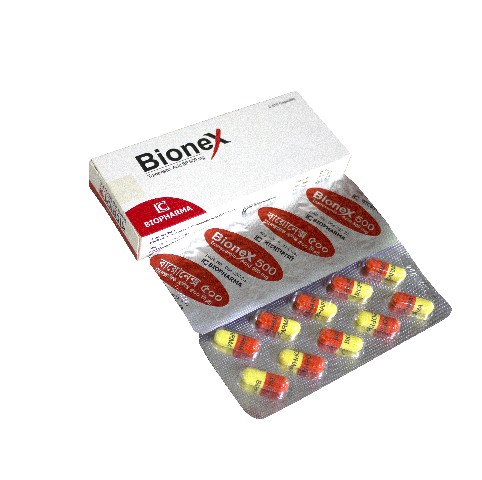
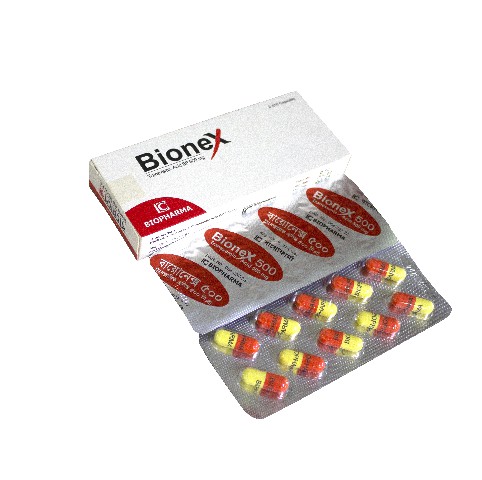
Bionex
Tranexamic Acid
Composition
- Bionex 500 mg Capsule: Each capsule contains Tranexamic acid BP 500 mg.
Pharmacological Actions
Tranexamic acid has a strong inhibitory effect on the activation of plasminogen, i.e. the conversion of plasminogen to plasmin, in the fibrinolytic system. The half-life is 1-2 hours. Plasma protein binding is 3% at therapeutic plasma levels. The plasma protein binding seems fully accounted for by its binding to plasminogen. Tranexamic acid is excreted unchanged in the urine.
Pharmacokinetics
Tranexamic acid is rapidly absorbed from the gastrointestinal tract. Maximum serum levels are reached within 2-3 hours. After oral administration, about 40% of the dose is excreted in the urine during the first 24 hours. After intravenous administration, 45% of the dose is excreted in the urine during the first day.
Indications
1. Haemorrhage or risk of haemorrhage in increased fibrinolysis or fibrinogenolysis that may occur in conditions:
- - Prostatectomy and bladder surgery
- - Menorrhagia
- Epistaxis
- Conisation of the cervix
- Management of dental extraction in patients with coagulopathies
- Ulcerative colitis
- Haematuria
Gastrointestinal haemorrhage
2. General fibrinolysis as in prostatic and pancreatic cancer, after thoracic and other major surgery, in obstetrical complications such as abruptio placentae and post-partum haemorrhage, in leukaemia and liver diseases and in connection with thrombolytic therapy with streptokinase.
3. Hereditary angioneurotic oedema.
Dosage and Administration
1. Local fibrinolysis:
The recommended standard dose is 15-25 mg/kg body weight, i.e.2-3 capsules two or three times daily. For the indications listed below the following doses may be used:
a) Prostatectomy: Prophylaxis and treatment of haemorrhage in high-risk patients should commence per or postoperatively with Tranexamic Acid Injection, thereafter 2 capsules three to four times daily until macroscopic haematuria is no longer present.
b) Menorrhagia: 2-3 capsules three to four times daily for three to four days. Bionex therapy is initiated only after heavy bleeding has started.
c) Epistaxis: Where recurrent bleeding is anticipated oral therapy 2 capsules three times daily should be administered for seven days.
d) Conisation of the cervix: 3 capsules three times daily.
e) Traumatic hyphaema: 2-3 cases three times daily. The dose is based on 25 mg/kg three times a day.
2. Haemophilia: In the management of dental extraction 2-3 capsules every eight hours. The dose is based on 25 mg/kg.
3. Hereditary Angioneurotic oedema: Some patients are aware of the onset of the illness; suitable treatment for this patient is intermittently 2-3 capsules two to three times daily for some days. Other patients are treated continuously at this dosage.
Children's dosage
- This should be calculated according to body weight, at 25 mg/kg/2-3 times daily.
Elderly patients
- No reduction in dosage is necessary unless there is evidence of renal failure.
Contraindications
- Active thromboembolic disease, such as deep vein thrombosis, pulmonary embolism and cerebral thrombosis
- Subarachnoid haemorrhage
Hypersensitivity to Tranexamic acid or any of the ingredients
Warnings and Precautions
- Patients with irregular menstrual bleeding and patients with a high risk of thrombosis (a previous thromboembolic event and a family history of thromboembolic disease) should use it only if there is a strong medical indication and under strict medical supervision.
- Patients with disseminated intravascular coagulation (DIC), who require treatment with it must be under the strict supervision of a physician experienced in treating this disorder.
- In the long-term treatment of patients, regular eye examinations should be performed. If a colour vision disorder should occur during the course of treatment, the drug should be discontinued.
Pregnancy and Lactation
Pregnancy
- Tranexamic acid crosses the placenta. Clinical experience of use in pregnant women is limited. Animal studies have not supplied any evidence of an increased incidence of foetal damage.
Lactation
- Tranexamic acid is excreted into breast milk, but it is not likely to influence the child at therapeutic doses.
Adverse Effects
Dose-dependent, gastrointestinal discomfort is the most commonly reported undesirable effect, but it is usually mild and temporary in nature. Allergic skin reactions have been reported as an uncommon undesirable effect. Hypotension may occur after a fast injection.
Drug Interactions
- Clinically important interactions have not been observed with Tranexamic acid. Because of the absence of interaction studies, simultaneous treatment with anticoagulants must take place under the strict supervision of a physician experienced in this field.
Overdose
Symptoms: Nausea, vomiting, dizziness, and headache.
- Treatment of overdose: If justified, initiate vomiting, then gastric lavage, charcoal therapy and symptomatic treatment. Maintain adequate diuresis.
Pharmaceutical Precautions
- Tranexamic Acid Injection should not be mixed with blood for transfusion or infusion solutions containing penicillin.
Storage
- Store at a cool and dry place, protected from light and moisture.
Commercial Pack
- Bionex 500 mg Capsule: Box containing 2 x 10 capsules in blister pack.
Biopharma Ltd. produces the BIONEX 500 MG CAPSULE, It is a trusted product for alleviating various discomforts, and it's commonly found in pharmacies and stores.


