
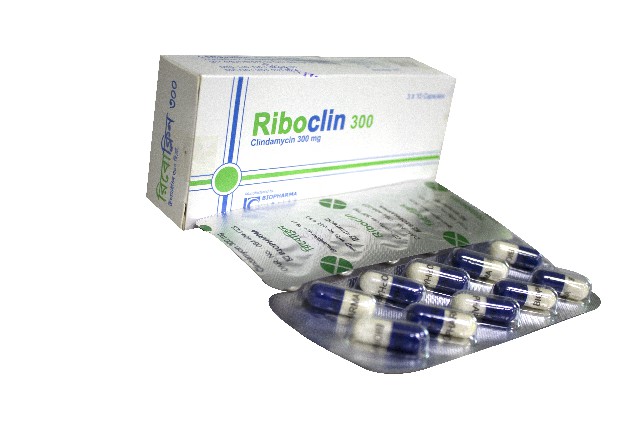
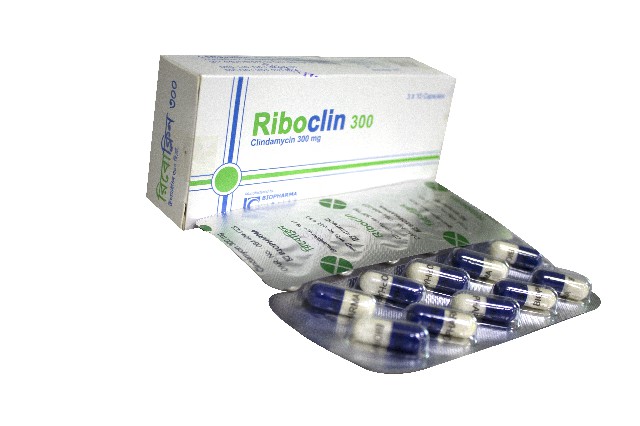
Riboclin
Clindamycin
COMPOSITION
Riboclin 300 mg Capsule: Each capsule contains Clindamycin Hydrochloride BP equivalent to Clindamycin 300 mg.
DESCRIPTION
Clindamycin is a lincosamide antibiotic used in the treatment of infections caused by susceptible microorganisms. Clindamycin is a semisynthetic antibiotic derived from lincomycin.
PHARMACOLOGY
Clindamycin is a lincosamide antibiotic. Clindamycin inhibits bacterial protein synthesis by binding to the 50S subunit of the ribosome. It has activity against aerobic gram-positive cocci, including Staphylococcus aureus, Staphylococcus epidermidis (penicillinase and non-penicillinase-producing strains), Streptococci, and Pneumococci. Anaerobic gram-negative bacilli including Bacteroides species, and Fusobacterium species. Anaerobic gram-positive non-spore-forming bacilli including Propionibacterium species, Eubacterium species, and Actinomyces species. Anaerobic and microaerophilic gram-positive cocci including: Peptococcus species, Peptostreptococcus species, Microaerophilic streptococci, C. perferinges.
PHARMACOKINETICS
Approximately 90% of an oral dose of Clindamycin is absorbed from the gastrointestinal tract and is widely distributed throughout the body, excluding the central nervous system. Adequate therapeutic concentrations can be achieved in bone. Clindamycin is extensively metabolized in the liver by CYP3A4. Clindamycin is primarily eliminated by hepatic metabolism and the metabolites are excreted primarily in the urine.
INDICATION
Clindamycin has been shown to be effective in the treatment of the following infections when caused by susceptible anaerobic bacteria or susceptible strains of gram-positive bacteria such as Streptococci, Staphylococci, and Pneumococci: upper respiratory tract infections, lower respiratory tract infections, skin and soft tissue infections, bone and joint infections, pelvic infections, intra-abdominal infections, septicemia and endocarditis, dental infections. As an alternative therapy when used in combination with quinine or amodiaquine for the treatment of multi-drug resistant Plasmodium Falciparum infection.
DOSAGE AND ADMINISTRATION
Adults
- Serious Infections: 150 mg - 300 mg every six hours
- More severe infections: 300 mg - 450 mg every six hours.
Pediatric Patients
- Serious Infections: 8 - 16 mg/kg/day divided into three or four equal doses.
- More severe infections: 16 - 20 mg/kg/day divided into three or four equal doses.
CONTRAINDICATIONS
Previous sensitivity to clindamycin, lincomycin, or any component of the formulation.
SIDE EFFECTS
- Gastrointestinal: Nausea, vomiting, abdominal pain, diarrhea, and oesophagitis, Skin: Pruritus, vaginitis.
- Hypersensitivity reactions: Rash and urticaria, Liver: Jaundice, liver function test abnormalities.
USE IN PREGNANCY & LACTATION
- Pregnancy: Pregnancy Category B: Clindamycin crosses the placenta in humans. After multiple doses, amniotic fluid concentrations were approximately 30% of maternal concentrations. Clindamycin should be used in pregnancy only if clearly needed.
- Lactation: Clindamycin has been reported to appear in breast milk. Therefore, it is not recommended for nursing mothers if clearly needed.
- Use in newborns and infants: When Clindamycin is administered to newborns and infants (birth to 16 years), appropriate monitoring of organ system functions is desirable.
PRECAUTIONS
Caution in patients with a history of gastrointestinal disease/colitis. Dose reduction may be needed in patients with renal or hepatic impairment. Prolonged administration may lead to superinfection.
DRUG INTERACTIONS
Clindamycin enhances the action of neuromuscular blocking agents. So, it should be used with caution in patients receiving such agents. Antagonism has been demonstrated between clindamycin and erythromycin in vitro. Because of possible clinical significance, these two drugs should not be administered concurrently.
OVERDOSAGE
Overdosage with orally administered clindamycin has been rare. Adverse reactions similar to those seen with normal doses can be expected, however, unexpected reactions could occur. Hemodialysis and peritoneal dialysis are not effective in removing clindamycin from the serum. Overdosage should be treated with simple gastric lavage.
STORAGE
Store in a cool and dry place, protected from light.
Commercial Pack
Riboclin 300 mg Capsule: Each box contains 3X10 capsules in an Alu-PVC blister pack.
Biopharma Ltd. Produces RIBOCLIN 300 MG CAPSULE it is a trusted product for alleviating various discomforts, and it's commonly found in pharmacies and stores.


