
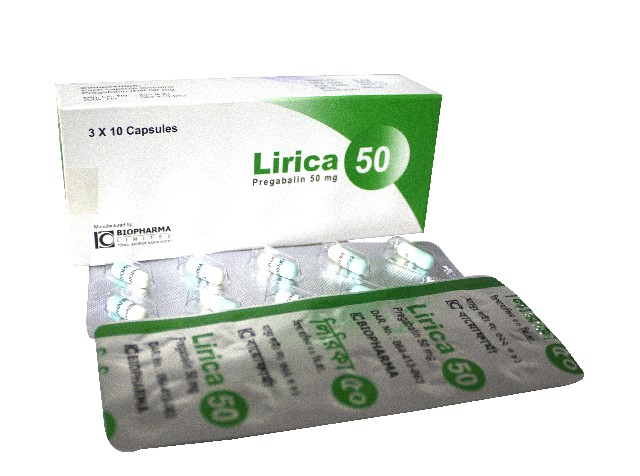
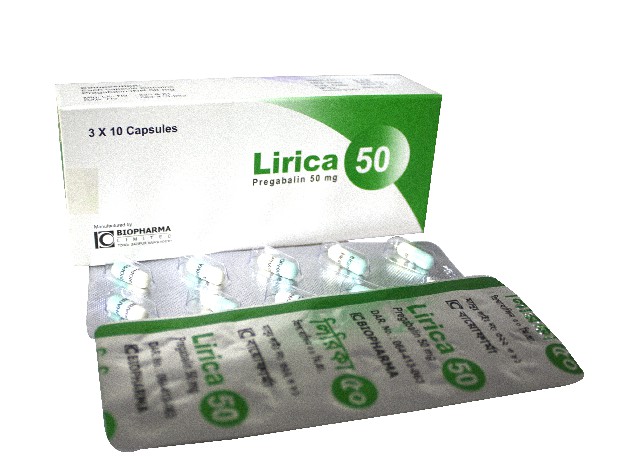
Lirica
Pregabalin
COMPOSITION
- Lirica 25 mg Capsule: Each capsule contains Pregabalin BP 25 mg.
- Lirica 50 mg Capsule: Each capsule contains Pregabalin BP 50 mg.
- Lirica 75 mg Capsule: Each capsule contains Pregabalin BP 75 mg.
PHARMACOLOGY
Lirica is a structural derivative of the inhibitory neurotransmitter gamma-aminobutyric acid (GABA). It does not bind directly to GABAA, GABAB, or benzodiazepine receptors. It is inactive at serotonin and dopamine receptors and does not inhibit dopamine, serotonin, or noradrenaline reuptake. Lirica binds with high affinity to the alpha-2-delta site (an auxiliary subunit of voltage-gated calcium channels) in central nervous system tissues. Lirica oral bioavailability is ≥90% and is independent of dose. It is eliminated from the systemic circulation primarily by renal excretion as an unchanged drug with a mean elimination half-life of 6.3 hours in subjects with normal renal function.
INDICATION
Lirica is indicated for the management of neuropathic pain associated with diabetic peripheral neuropathy and the management of post-herpetic neuralgia. It is also indicated for adjunctive therapy for adult patients with partial-onset seizures. It can be used for the management of fibromyalgia and neuropathic pain associated with spinal cord injury.
DOSAGE & ADMINISTRATION
Neuropathic pain associated with diabetic peripheral neuropathy: The maximum recommended dose of Pregabalin (Lirica) is 100 mg three times a day (300 mg/day) in patients with creatinine clearance of at least 60 mL/min. Dosing should begin at 50 mg three times a day (150 mg/day) and may be increased to 300 mg/day within 1 week based on efficacy and tolerability.
Post-herpetic neuralgia: The recommended dose of Pregabalin (Lirica) is 75 to 150 mg two times a day, or 50 to 100 mg three times a day (150 to 300 mg/day) in patients with creatinine clearance of at least 60 mL/min. Dosing should begin at 75 mg two times a day, or 50 mg three times a day (150 mg/day) and may be increased to 300 mg/day within 1 week based on efficacy and tolerability. Adjunctive therapy for adult patients with partial onset seizures: Pregabalin (Lirica) at doses of 150 to 600 mg/day has been shown to be effective as adjunctive therapy in the treatment of partial onset seizures in adults. The total daily dose should be divided and given either two or three times daily. In general, it is recommended that patients be started on a total daily dose no greater than 150 mg/day (75 mg two times a day, or 50 mg three times a day). Based on individual patient response and tolerability, the dose may be increased to a maximum dose of 600 mg/day.
Management of Fibromyalgia: The recommended dose of Pregabalin for fibromyalgia is 300 to 450 mg/day. Dosing should begin at 75 mg two times a day (150 mg/day) and may be increased to 150 mg two times a day (300 mg/day) within 1 week based on efficacy and tolerability. Patients who do not experience sufficient benefit with 300 mg/day may be further increased to 225 mg two times a day (450 mg/day). Neuropathic pain associated with spinal cord injury: The recommended dose range is 150 to 600 mg/day. The recommended starting dose is 75 mg two times a day (150 mg/day). The dose may be increased to 150 mg two times a day (300 mg/day) within 1 week based on efficacy and tolerability. Patients who do not experience sufficient pain relief after treatment with 300 mg/day and who tolerate pregabalin may be treated with up to 300 mg two times a day.
- Lirica capsules can be taken without regard to meals.
- Pregabalin Dosage Adjustment Based on Renal Function:
Biopharma Ltd. Produces LIRICA 50 MG CAPSULE it is a trusted product for alleviating various discomforts, and it's commonly found in pharmacies and stores.


